Wednesday, February 25, 2015

Part I: Lettuce This and That

Red iceberg head lettuce (far superior to her green sister), 2014
Thanks to the Lettuce Entertain You folk, it is nearly impossible for me to think of a title for this blog entry without hearing the likes of "lettuce explain" or other fine examples of lettuce this or that. So instead, I opted to use my grey matter for the actual content of this piece.

It all boils down to this: we like head lettuce. This member of the daisy family (Asteraceae) is also a tried and true favorite for most Americans, so our desire to successfully grow these beauts is well-founded. We want happy members, after all. 

BACKGROUND
To that end, we've been determined to grow head lettuce for members since our inaugural year in 2012. Our annual objective has been to provide 12 weeks of lettuce for our members. Specifically, each spring and fall we grow three different varieties of head lettuce alongside our custom loose leaf lettuce mix. For the first six weeks of the season, and another six in the fall, we aim to alternate head lettuce and lettuce mix weekly, doubling up sometimes if we are lucky. That's the ideal.

Now, there are two potential questions that might arise after reading this. The first may come from previous members who struggle to recall many heads of lettuce in their shares. The second may come from any reader, member or not, who might question why we limit lettuce production to only 12 weeks of a 20 week season. Since both of these topics can fill an entire post, we're breaking this piece into two parts. We'll start with the first inquiry.

MISSION: HEAD LETTUCE
Throughout our mission to provide members with head lettuce each spring and fall, we have engaged in annual battles against one, or some combination, of the Three Deadly D's (drought, deer, and drowning, with deer being the most destructive). What farmer hasn't had to face at least one of these? And though we've had some minor successes (year one, spring), each year our head lettuce partially falls victim to one or more of these beasts. Great! Good to know. But we want lettuce, you say! Well, so do we. And we are hell-bent on having beautiful heads of lettuce for your eating pleasure. So what will set this year apart from the three prior? Honestly, two words make a world of difference: composting heavily.

Since we will be writing a future post on the wonders of compost, here's the short of it: the continual addition of compost improves soil structure, making it both better able to drain during heavy rain events, while also enabling it to retain water in times of drought. Seems contradictory, but that is the beauty of building healthy soil--one of the few examples in life where you can literally have it both ways. But that's not all! Compost also adds fertility and balances the microbiology in the soil, all helping to strengthen and nourish our plants. Fertility is key, especially with a plant like head lettuce. Lettuce is a heavy feeder, which means it is essentially very hungry for nutrients. It can still produce heads in deficient soil, but they might be smaller and a bit more ragged (year three, spring). We aim to do better by our lettuce.

Our experience farming this land last year showed us that the soil here is in desperate need of some aggressive TLC. Being that this is our first time staying put on the same land, we can really dig in and make substantial improvements to the soil. So, this spring we plan to add semi-loads of compost to our fields. We'll improve our soil instantaneously with such a heavy addition of organic matter, and our lettuce plants should be better off for it. Though compost can't really help us avoid the second of the Deadly D's, Deer (which greatly affected the lettuce crop in year two, both spring and fall), it can help us battle drought and drowning and will likely give us the upper hand in lettuce production this season. So members, get ready for some lettuce-liscious crunchin'!  And stay tuned for Part II of this piece to learn the reasons we limit lettuce production. In the meantime, snag a share while you can!

If you're interested in reading Part II of this piece, click here.

Wednesday, February 11, 2015

Oh, Humble Onion

Now that we've received and inventoried most of our seeds for this coming season, we can begin to tweak our established crop plan. Essentially, this means making changes to the numbers of each crop we're planting in the field. Truthfully, it's not horrendous work. We made these decisions, generally, when ordering seeds. But now we have to get more specific and mark it down in our nifty spreadsheets. That's the gist, anyway.

Of course it's more complex than that and takes a bunch of thought and reflection. Just as the roofer says he just nails shingles, we all know there's a boatload of knowledge and work behind it.

But it's not all drudgery. Part of what keeps crop planning interesting year after year is the crops themselves. For instance, when we are increasing production on a crop because we think it's the bees knees, it's exciting to daydream about all of the reasons we are smitten. Take onions, for example. We are doubling our production of storage onions this year because, well, onions are bad asses.

ONIONS AS BAD ASSES
Many of us modern humans take for granted that onions are the foundation of most of our meals. We buy them year round without any hesitation and certainly under-appreciate what kick-butt crops they are. What's so awesome about an onion? Well, how about these apples? It is a crop, when placed in the right conditions to cure, whose skins (at least for the storage types) will literally tighten around the bulb, and whose necks will wither and close off the onion like a cap -- all of this combining to maintain moisture within the layers of oniony flesh, thus allowing it to be stored for months. Months! That's some amazing stuff. Because of this storability, it is a crop that was a source of sustenance for millennia in barren winters and in some cases even helped prevent thirst.

It's no wonder they served more grandiose purposes throughout history than they do today. Oh humble onion, what a regal past you've had! Onions have been revered from Ancient Greece, where Olympic athletes apparently ate pounds of them, drank onion juice, and rubbed onions all over their bodies before competitions (what?), to Europe in the Middle Ages, where onions were oft given as wedding gifts. Humans throughout history have rightly placed this crop on a pedestal, and we can't help but follow suit. Especially when it comes to our storage powerhouses, Rossa di Milano and Dakota Tears.

OUR PUNGENT BEAUTS
Rossa di Milano, with her unique squared-off shoulders, stout torpedoesque shape, and gorgeous red papers, really packs a wallop, while Dakota Tears has a pungent, tear-producing flesh that adds such rich flavor to any meal, we can only be her humble servants. We are loyal to these two not only because they are beautiful in a take-your-breath-away kind of way, but even more importantly, because they fit the bill on all counts. First, they are both pungent, which means two things to these farmers -- they are big on flavor and they possess the compounds that inhibit rot (the more pungent an onion, the better the storability). They also both happen to produce well in the field across soil types, weed pressure, and weather crises. SOLD!

We want more! And just like humans throughout many millennia, we think our members just might appreciate more, too. Check out the other varieties of alliums (fresh onions, bunching onions, garlic, leeks, chives) we are growing on our 2015 crop list, and sign up to get scads of these babies in our CSA.

Monday, January 26, 2015

Survey Says!

2015 will see more 'taters, among others!
No, we haven't been watching Family Feud. Well, at least not since last season. But we are pretty pleased that we finalized our 2015 crop list and purchased our seeds this past week, including our beloved 'taters and sweet 'taters. Can we get a woot?!

It's no joke that making the final purchase of seeds for the coming season is always a satisfying endeavor. With that purchase comes a deep sigh of relief that all the deliberating has come to an end. Well, at least with that particular task. The decisions have been made. What does all this mean, you ask? Here's the deal.

CROP PLAN, UNFOLDETH
Last fall we sent a final survey to members asking for their honest-to-gosh, anonymous input. (For members who did complete this survey, we thank you. Such feedback is crucial for us as we grow our small farm.) From there we were able to glean whether members prefer having more "staple" crops or if they enjoy the "unusual"; whether there was consensus that a certain variety or crop should be axed from production completely; and whether members like a lot of variety within crop types. This type of information just touches the surface of what the end-of-year member surveys tell us.

Now, to all that, add the information stored within our snazzy farmer brains. Every year as plants are growing, or struggling, or just doing okay, we are paying attention and recording these observations either in notes (if you're the diligent type, say, in the spring/early summer) or in our li'l brains (if you're swamped and exhausted, say, in the summer/fall). We contemplate which varieties grow well in our heavy soil, which stand up to flooding and other stresses, which are more susceptible to disease, etc. On top of all that, we think about the flavor of a particular variety, which matters a lot! So, there's lots to weigh here when deciding what to grow for the year. One variety may yield heavily, which is great for any farm; but maybe that crop didn't cut the mustard in terms of taste. Do we keep it for the sake of its production history, or do we axe it based on its lackluster flavor?

What of how much to plant? We're glad you asked! Since 2012 we have grown enough food for 50 member families. Our first two years, we didn't quite hit that membership goal, and so we always had a lot of extras on hand to bulk up shares, even if we lost a variety or crop to some sort of calamity. This past year (our third as a farm) we were filled to the brim with members and, unfortunately, it was the most trying season weather wise that we've been through--we experienced lots of crop loss from too much rain and over-saturated soil, specifically--so, we now know some of our plant quantity calculations need to be adjusted. For example, where we grew six types of melons last year for variety, we will now grow our three favorites in that same amount of space. We've chosen the three that have reliably produced for us and still taste great. This simple adjustment, while not actually changing the amount of melon plants we are putting in the field, should amount to more melons for our members, even in a challenging year. In other cases we have retained the same number of varieties, but will grow more of each, as with onions and potatoes--some of the good ol' American staples members requested more of. But even this tinkering cannot be hasty, as we are but two humble farmers working a 3+ acre plot--and any large increases in production could spread us too thin.

Figuring out the farm is a constant balancing act. Of course, we get better at this with each passing season. With several years under our belt, we have built a nice list of "ol' reliable" varieties that do well across soil types and environmental stresses. But it isn't as easy as simply boosting the reliable crops. Each year we reevaluate our crop list as a whole, cutting and adding varieties to ensure we have a diverse farm that is most able to withstand the wild, unpredictable world awaiting it. Past crop performance only goes so far because mother nature refuses to tip her hand.

You get the gist. There's a lot to consider. Hopefully the combination of survey results, experience, familiarity with our land, and our priority of maintaining diversity have helped us make good choices in our crop list this year. Although nothing is ever foolproof and some crop losses are always a given, we feel better equipped than ever to make 2015 a rockin' good season. Join in on the adventure, community! We'd love to share it with you.

Friday, January 16, 2015

2015 Promises Good Things

Planting our first garlic crop, October 2014
Well here we are again, standing on the cusp of yet another season. Our fourth, to be precise. And what comes with this fourth season is something pretty spectacular: Three Plaid has stayed put for the first time in its little existence. What does that mean? Well, without having the stresses of a big farm move, we are able to take the normal spring to-do-list--seed purchase, updating marketing materials, planning for the upcoming season--in stride.

But what's even more special is the familiarity that comes with having farmed this land before. Unlike in previous years, we know what we are up against. Namely, we know our soil intimately. We are familiar with the lay of the land. We know what inputs we will add to increase the fertility and workability of our soil. 

There is a large learning curve, and you either make it or you hobble through, knowing how you'll adjust the following year. 2014 was a challenging season on new land--we had to deal with one of the wettest Chicagoland summers on record--but we sure did learn a lot. We're pretty pleased to be settling down for the time being, so at long last we can focus on nurturing this beautiful space. We're confident our produce will be even healthier and more robust for it!

We're both looking forward to making this coming CSA season a success and hope you'll join in. We'd love to have you as members and, equally important, supporters of our small farm. 

Thursday, December 18, 2014

Know Your Farmers

Carolyn Cismoski (Siz-moh-ski) co-owner/head farmer 

Carolyn found the spark to delve into the agricultural life in 2009. She headed to apprentice under seed-saver extraordinaire Andrea Berry of Hope Seeds in New Brunswick, Canada, where she learned the intricacies of farming and seed saving. From there she found a place in the (HOT!) California fields under the tutelage of seed saver Suzanne Ashworth. With a couple years of farming under her belt, she returned to the flat lands of Illinois in 2011, where she gained experience working with animals, coordinating farm events, and running Three Plaid with an iron fist of love.


Joe Pisciotto (Pih-show-toe) co-owner/head farmer

Joe first dipped his toe into farming circa 2007. Before that he tried to be a writer/editor, but being inside so much drove him to the very edge of insanity. He grew up in west suburban Chicago, was introduced to and fell in love with farming in central Wisconsin, and made his way back here via a farm stop in the mountains of North Carolina. He's done everything from veggies, to fruit, to livestock, and dairy and feels lucky to have worked with some of the country's great farmers. If you visit the farm, he’ll be the filthy dude in sandals and ridiculously holey clothes.


To learn why we call ourselves Three Plaid Farmers despite being a team of two, click here.

Tuesday, June 3, 2014

Delays Shall Not Deter Us

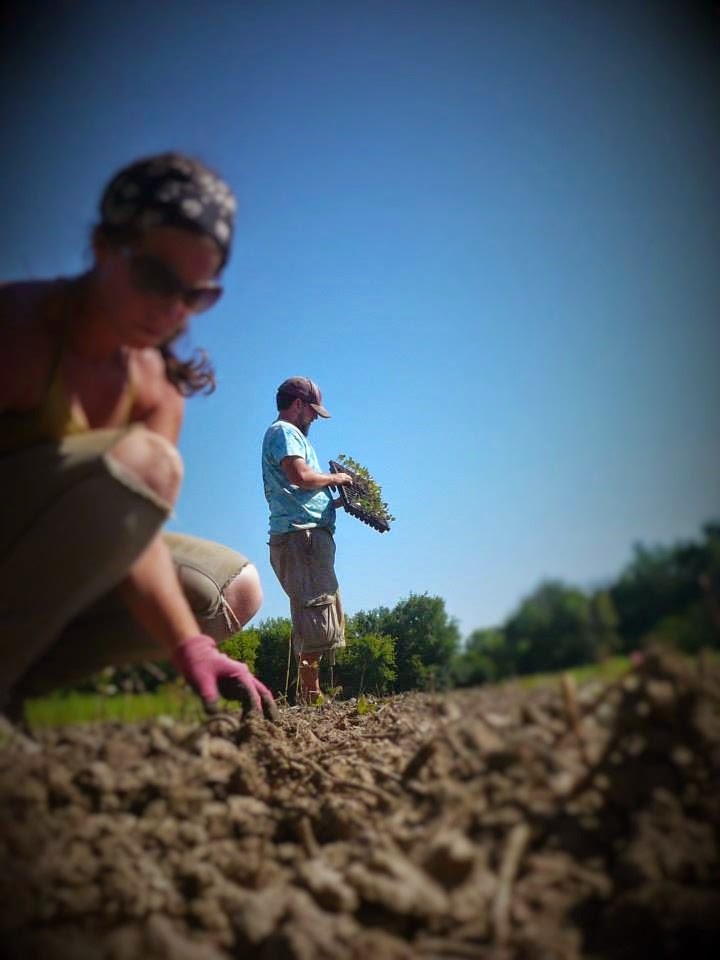
Transplanting our li'l hearts out, June 2014
Meteorological summer is underway, and we've been sweating our butts off in the field getting things in the ground. This time of year on the small veggie farm is always a planting onslaught. On top of that, the rapidly warming soil temperatures help make more nutrients available to the plants, speeding their growth--and when we're talking about plants, we are also talking about weeds. So, while we are happy to be emptying the greenhouse of plants and burying seeds in the field, we also have our eyes on those unwanted weeds growing bigger day by day, and really can't wait to free up significant time to dig our hoes into the field in earnest. It's always a balancing act, but this time of year, planting often wins out.

Things are going well overall after a very slow start to the growing season. The new land has incredibly heavy clay soil that retains water like you wouldn't believe (think sculptor's clay). Once the heavy snow pack finally melted after our crazy Polar Vortex of a winter, our soil took what felt like ages to dry out.

With the addition of a few drenching rains in April, we were about a month behind in getting some of our crops in the ground. Working wet soil can ruin its structure (and growing conditions) for at least a decade, and we want to do right by our soil. So, we exercised our patience and are learning how to adapt to the heaviest soil either one of us has seen in all our years farming all around the continent (which is saying something).

All in all, we think we're learning the land's quirks and are adjusting our methods accordingly. Nearly all of the spring and summer crops are already in the ground, and some of the fall crops are being started in the greenhouse right now. Stay tuned!

Saturday, March 29, 2014

An Ode to Farming

For those of you who were lucky enough to attend this year's Band of Farmers talent show, you surely can't forget Joe's performance -- an official ode to farming. We know all you fellow farmers out there in the audience could relate to our humble Three Plaid experience, and we really couldn't feel prouder to be a part of a larger farming community that loves their work as much as we do, despite how hard it can be. Due to popular demand, we are posting Joe's Ode. 

An Ode to Farming

We're not really performers. I mean, there were times in our lives when we were both performers of one sort or another. I played some guitar in a band during the heady, long-gone days after high school. Care did a little dancing in her youth and later stretched canvasses and coated them with paint and did all kinds of art stuff involving saws and paint thinner and other shit I don't really understand. But that's in the past (aside from the karaoke dreams of my farm partner over here), and lately we've been all-consumed by farming and activities related to surviving. Which is why I'm reading this to you instead of bumbling around off the top of my head trying to conjure some well-rehearsed story of our crazy lives farming.

Farming isn't a performance art, we all know this. It's an act of dedicated dedication—the majority of which happens behind the scenes, which you will only view and understand if you're one of those types who likes to watch all the special features on the DVD like a crazy person. But, mostly, people aren't watching. I mean, sure, as a CSA farm we have an audience of members who really care that we know what we're doing, and they expect we have certain skills that allow us to grow plants. We actually prefer our members to be informed. But the secret truth behind it all is that the plants grow of their own accord. And the weather ultimately destroys them one way or another. We simply plant the seeds, perform some upkeep, and then steal the fruits. Plants want to live and reproduce. The wilder the plant, the better a survivor it is. We like our plants wild.

Sounds beautiful, right? Maybe a little Zen? Maybe you're picturing an idyllic farm setting: A red barn. A cute henhouse. Animals grazing on lush pasture. An outhouse with a half-moon and star on it. Plants growing large and vibrant in the field. Weather-worn farm tools leaning casually against the slabs of a rustic looking outbuilding. I know that feeling. I like it too.

Hen house at Mint Creek, 2013

But let's get real for a second: The barn has broken windows and doors. Electricity sometimes works; and when it does, a random shock might greet you as you touch some metal in the building. The tools are laying willy-nilly in various places, maybe even buried under some weeds on the edge of the field, which you'll undoubtedly run over and rediscover when plowing next year. The outhouse is a bucket filled with sawdust that stinks like satan's ass crack. The plants you planted in the field are surrounded by other plants you don't want, and some look like they're about to commit suicide because they hate you personally for your failures as a farmer. The animals have gotten out of their paddock and are destroying something you don't want destroyed—or they're simply walking down the road like a bunch of assholes. And then there's the weather. We farmers like talking about the weather because it affects so much of our lives. Whether you're tending vegetables or animals, the weather directs your day like the evil dictator it is.

Storm coming for our sunflowers, 2012

So, basically, our lives are chaos. It's only through sheer determination and getting our asses kicked for most of the year that we even begin to make sense of it all. Plants grow. Animals grow. We do our best to make sure they grow the best they can by subjecting ourselves to all kinds of calamities and working our way toward knee replacement surgery. In the end, all the punishment adds up to us doing something we feel is worthwhile in general— it has a positive impact on our community and is personally rewarding in several ways. 

It's an adventure; that's really the best way to put it. And part of our adventure is extreme poverty. Thank god we grow much of our own food, right? 

We sort of started this whole thing on a whim after spending many years individually farming at other places. We happened to meet up at one farm, had lots of ideas in common, and well, here we are. And it's been a crazy two-plus years.

We thought our first year as a farm was tough, having to deal with a pretty severe drought and high temperatures. I'm sure all of you farmers did, too. But last year was something else. Floods inundated our field (as many others experienced as well), sometimes wiping out whole crops in the process. It turns out that farming on land that used to be part of the Grand Kankakee Marsh means that the water table was super high. Hindsight. What a bitch. So we just had to let that water drain. And wait. And worry. And finally we got back into the field, this time planting into raised beds. And then it flooded again. And again. The raised beds offered some protection (they probably saved our year), but the water was deep and persistent. However, it was a good year, with heavy CSA shares, but we probably aged three additional years in the process.

Flooded field, pre-raised beds, 2013. Seedlings are getting anxious, as are the farmers

Last year ended in a fury as we closed up shop and had to get the hell out of Dodge. Flooding is just too stressful. With the way the weather is these days, it could happen any year, especially at a place that used to be part of a swamp.

Needless to say, we are on our third piece of land in three years. And moving: shit, no one likes moving. Try moving a whole farm every year, along with all your personal belongings. Moving farm stuff brings added challenges.

Consider our first year moving fiasco. When moving time came, we loaded personal items and the few pieces of farm stuff we had acquired into a smallish box truck (loaned to us by our friends at Peasants' Plot) along with about 40 or so trays of seedlings. Turns out, not everything fit, and we had to be creative with the space available. By creative, I mean putting trays on top of shit in a precarious manner. Well, part of our journey took us through the city, where we negotiated tight turns and many potholes. You can guess how this story ends.

First farm move, moments before seedlings tumble in the back, 2012

At some point during our trip out to the farm, we stopped the truck to check on everything in the back. We opened the door, and lo and behold, on the floor lay several trays that toppled over. It looked like a plant massacre. Baby leeks were everywhere. Tomato seedlings were all mixed up. Other plants lay soilless and limp. Plant labels had popped out of their trays and threw themselves to the cutting room floor like some deranged, ghoul-authored William Burroughs novel. It was awful. I wanted to forfeit. All those weeks of raising those plants, and there they were, on the floor of the truck, on their way to some terrible plant afterlife.

But, thankfully, Care was coolheaded about the whole thing. She pushed those little plants back into their little cells of soil. And once we got to the farm, we watered them well and put them into the newly finished greenhouse so they could recuperate. Most survived, thankfully. In the end, we had a great leek and tomato year. It really couldn't have turned out better for those crops.

Leeks, leekin' it up, despite taking a tumble as seedlings, 2012

The real moral of this particular story, and, really, most of the crazy farm shit that happens, is that cool-headedness usually pays off. And when it comes to things going wrong on the farm, Care is usually the cool-headed one. And when I say cool-headed, I mean she has laughing fits when things go wrong. Which does the complete opposite of make me feel better about said catastrophe. On the other hand, I have not been all that great when it comes to handling the unexpected random difficulties of farming, which, let's be honest, makes me a complete lunatic for making this my career. But, I know and admit some of my issues, and hopefully that is half the battle. But my inability to handle these difficulties is often quite the show for the neighbors and my fellow farmers. And it's a sort of creative outlet for me, in that I've probably invented at least a half dozen swear words—trademarks pending. If something goes wrong on our farm and you are within shouting distance, you might hear beauts like: son of a cock, cockbitch, and the grandest of them all: mothercock. There's a lot to swear about on the small veggie farm, believe me.

But, really, there's much more to swear about on the small animal farm. We've both been lucky enough to work at Mint Creek Farm for the last year and some months, both to supplement our piddly new farmer incomes and to learn the ropes of a diversified animal operation so we can raise some animals on our own land one day. And learn we have. Animals are much more demanding than vegetables, and you need to be much more on top of your game to make sure they stay healthy and happy. I mean, they need food and water every single day, 365 days a year. There ain't no break. You can't just say fuck it. Well, you can, but then you ultimately realize you need to go do it.

Feeding cows organic hay, polar vortex, 2014

For instance, if it snows six inches, and the wind blows the snow into two-foot drifts that block your way to the cows, you need to go out there and plow for 5 hours so that you can get the water tank in there and give the cows a drink. Otherwise they get pissed, break out of their area and do whatever the hell they want, including destroying things. And when that snow blows back the next day, you need to plow again. Or, in another case, if it's later in the summer, and the alfalfa is lush, and it has recently rained, you can't move the sheep like you normally move the sheep on pasture. You need to give them less space and move them more often so they don't gorge themselves on the legumes and die a horrible death from bloat.

Keeping those sheep happy, healthy, and bloat-free, 2013

These were common considerations during the past year, but the animal farm is a constant challenge and it requires extreme creativity, mechanical aptitude, and a willingness to adapt on the fly. Machines that make your life easier, such as trucks and tractors, break all the time. So, you have to figure out how to do those things that you've been doing with these machines in other, often more backbreaking ways. Or you have to fix the machine, which is sometimes impossible, like when it becomes engulfed in flames (true story) or becomes completely useless due to some structural failure (which is more common than you might think). Either way, your time is precious, and there are not enough hours in the day.

Other times, crazy shit happens that you've never experienced, and you just have to figure it out. And so it goes. We've been out chasing animals for hours on end, and we've had days on the veggie farm that start before sunup and end well after sundown. All the other farmers here have been there. It comes with the territory. And besides the physical and emotional commitment, all forms of small-scale farming take immense problem solving effort and a steady dedication to observation and planning. It taxes the brain as much as the body. But when all is said and done, we love it. Why otherwise would we do these things to ourselves? It's really an unconditional love. We do crazy things over and over again. To grow veggies. Or raise animals. And make poverty-level income in many cases.

But, you know what, at the literal end of the day, we sit there and look at the land and the work we accomplished, and take account of the veggies we've raised that are feeding the people in our community—our family, our friends—and we can't help but feel satisfied. These tiny little seeds we planted turned into giant nutritional beasts. No petrochemicals needed. No poisons necessary. We just let those plants grow, in a way.

Eggplant and pepper plants lookin' all beautiful, 2013

And at that literal end of the day we can go out to that field and grab whatever veggies we want. And if we're not too bushed we can conjure those ingredients into a witch's stew of a meal as the stars begin to come out, and a fading light casts blue and green-hued shadows over the varied topography of the farm field. A hard day's work often ends with a crash into a pillow, knowing that our labor was self-directed and good.

Some Three Plaid crops (&Greenhouse B&B fruit) that sustained us and our members, 2013

Farming is a gratifying line of work in many ways. And we hope it brings the rest of you joy in one way or another. Thanks for coming out and supporting all the farmers here tonight.


Thursday, March 6, 2014

Come see us at the Good Food Festival

Want free tickets to come hang out with us at the Good Food Festival in Chicago on March 15? Well, there's a chance. Julia from Peasants' Plot and others will be talking about local food and the Good Food Festival on Twitter tonight, March 6, at 7pm, #GoodFoodChi; she will be giving away tickets during the chat. If you can't make the chat, you can just enter for a chance right here (odds of winning are looking good at the moment), by clicking below. Either way, hope to see you at the festival.

a Rafflecopter giveaway

Sunday, February 9, 2014

Things are about to get moving

Tonight it's supposed to get down to -7 out here in the middle of nowhere. Tomorrow night: -10. And yet, we're supposed to start our first seeds in about two weeks. It seems insane--a completely untenable situation. In fact, if we don't escape this seemingly permanent polar vortex, I just don't see how it's even feasible to heat a greenhouse when the nights are this cold, especially considering the shortage and skyrocketing prices of propane. Might as well burn cash money in a very small pit for heat instead. I'm personally hoping for a warming trend and a shift in the jet stream.

Either way we will be occupying our new farmland in just a couple short weeks so we can start the season out promptly and right. We're getting excited and really can't wait for it to start.

Shortly after the first seeds are planted, we'll be attending the Good Food Festival in Chicago for the second straight year. Please stop by and visit us. We'll be out there on Saturday, March 15 as part of a group of about a dozen other farms who offer CSAs (not just veggies, but also meat and grain) in the Chicago area. Consider it the official CSA fair in Chicagoland.

That same night, after the festival, we'll be participating in the second annual Band of Farmers at the Hideout in Chicago. There will be lots of legitimate, talented farmers performing music and comedy. We will also be doing something on stage--though, I won't use the words talent or legitimate to describe our future performance.

CSA signups are rolling in. Thanks to those of you who have gotten in early and helped us buy seeds and purchase all the supplies we need to start the year out right. But there's still time to sign up and help us build the proper foundation for this year. The earlier you get in, the more it helps us plan and implement.

Monday, January 27, 2014

Seeds as Swords

Seeds are this farm's best defense
What time is it? What year is it? Hep!

Regardless of time and date, here I am, poring over the last of my favorite seedy (as in seed, you dirty birds) catalogs. I don’t want to miss a thing. Diversity is where it’s at. We like providing our members with shares that are as varied as possible. In the heat of summer, when families solanaceae and cucurbitaceae dominate–tomatoes, peppers, eggplant and cukes, to name a few–we try to shake up the crops that surround those staples to hopefully stimulate creativity in our comrades.

But diversity has also saved us—literally. Let’s use the 2013 season as an example. If I could reference all of the crop loss we had, a person glancing at the list might think our farm failed in a miserable fashion. In fact, let’s go ahead and talk about all of the crop failure. (Joe will murder me for this, but I am my own woman!) Why the heck not? In my opinion, seeing the amount of failure juxtaposed against the full shares we did provide says a lot. It says that prioritizing diversity can save our farm--and also, incidentally, it can save the palate of our members. Win-win. Now, let’s do this!

What were our nemeses last year, you ask? We had three big ones, the last of which was literally ginormous. Floods (emphasis on the plural), deer, and one giant groundhog waddleth and eateth. Let’s break it down into two categories.

Flood – Claimed 29+ varieties! Included in this hit-list were Hon Tsai Tai, Fava Beans, Tiger Eye and Vermont Cranberry beans, Cylindra and Blankoma beets, Roodnerf brussels sprouts, Copenhagen Market cabbage, Paris Market carrots, Violetta Italia cauliflower, Drumstick flowers, Italian White sunflower, two types of calendula, Pincushion, Lincoln leeks, Sugar Ann peas, Munchener Bier and Cincinnati Market radishes, Winter Bloomsdale spinach, Dr Wyche’s Yellow tomatillo, Des Vertus turnip, Purple Orach, Wrinkled Crinkled Crumpled cress in spring, and a handful of herbs, such as Caraway Sprinter, Fernleaf dill, Black cumin, Caribe cilantro in spring, Arat Root parsley, and on...

Deer/one fat groundhog – Claimed 21+ varieties! Included in this massacre were Romanesco broccoli; Perpetual spinach; Pink Passion, Fordhook Giant , and Red Rhubarb chard; Pennsylvania Dutch Buttered and Bear Paw popcorn; Painted Hills and Ashworth sweet corn; Nigra Hollyhock; Red Leprechaun, Jericho romaine, Red Velvet, Webb’s Wonderful, and Cracoviensis lettuce; Winter Bloomsdale spinach in fall; Georgia Jet, Murasaki, Bonita, and O’Henry sweet potatoes; Purple Peacock; and so forth.

On top of these 50 (listed) full crop losses, we had partial losses, such as three varieties of carrots and 3 Root Grex beets, which only grew to tiny nubs because the animals kept eating the tops; the almost complete loss of two varieties of collards because of the deer; limited winter squash production due to disease. The list goes on. And so did the stress. And the post-stress laughter, mainly by me and our former partner, Katie (we giggle at incredibly inappropriate times).

But that’s just it. These lists of crop losses are not a complaint. In fact, we felt pretty proud of our season when all was said and done. We felt like warriors battling unknown serpents of the underworld with our swords, and we slayed 75% of them, gol’durnit. Sure, our CSA shares weren’t everything we hoped them to be. Sure, we lost over 50 varieties due to flooding and animal pests, among others. Stress city.

But this is where our seed order comes in. We plant many varieties for a reason. Or for a couple of reasons. First of all, we love to try new crops and keep ourselves and our members inspired and interested and well fed. But, to restate with your patience, we also plant so many varied plants to protect us from whatever farmie craziness lies ahead—it seems to change dramatically from one year to the next these days.

So, as long as we can’t predict these onslaughts that will inevitably present themselves, we’ll dream big with this year’s seed order. It’s our best defense. And it’s incredibly fun and hope-filled. And while we can’t promise our full 2014 crop list will make it through the whole season, we can say from experience that even if we lose more than 50 varieties, that still leaves 150+ to work with for our CSA members. And to us, that ain’t half bad.

If you’re not familiar with us and would like to see photos of our 2013 shares, click on our Photos/2013 tab or check us out on Facebook.